

Indonesia’s Economy Is Accelerating — What It Means for Lombok Property Investment and Hospitality Real Estate
Indonesia grew 5.61% in Q1 2026. Here’s what that means for Lombok property investment, Mandalika SEZ, and branded hospitality real estate in South Lombok.
By Tim Hallett, Founder, Selo Group
Indonesia’s economy grew 5.61% in the first quarter of 2026 — its fastest pace in nearly four years. That single number tells a more complete story than most property brochures, and it is the number I return to when assessing the long-term case for hospitality real estate and Lombok property investment.
For anyone tracking Indonesia real estate investment, the macro signal is now unambiguous. The question is whether you are positioned ahead of the capital that is already following it.
Indonesia’s GDP Growth: What the Numbers Actually Signal
Indonesia’s GDP expanded 5.61% year-on-year in Q1 2026, according to Statistics Indonesia (BPS) — the strongest quarterly reading since Q3 2022. It follows full-year 2025 growth of 5.11%, with Q4 2025 accelerating to 5.39%. The Government of Indonesia has maintained its growth target of 5.4% for 2026.
To contextualise these figures: Indonesia is Southeast Asia’s largest economy, operating at approximately US$1.4 trillion. When an economy of that scale sustains growth above 5% through a period of global uncertainty — and when the most recent quarter is the fastest rather than the slowest — it materially shifts the risk profile of long-dated assets within it.
Resort real estate is a long-dated asset. The investors who get it right are almost always the ones who read the macro trajectory correctly before the wider market does.
The most recent quarter is the fastest, not the slowest. In a long-dated asset class, that direction matters as much as the number itself.
Why Macro Stability Is the Foundation of Hospitality Real Estate Returns
Property returns are built on top of macroeconomic stability. You cannot have durable occupancy, currency confidence, or exit liquidity in an economy that is contracting or volatile. This is why I read national growth data before I read any local price sheet.
For Indonesia real estate investment, the macro case is reinforced by structural factors that extend well beyond quarterly GDP: a young, growing domestic middle class; rising outbound and inbound tourism; and a government policy environment that has prioritised infrastructure-led development across the archipelago for over a decade.
Destination development at scale does not happen without macro conviction. The numbers confirm that conviction is already in place.
The Mandalika SEZ: Sovereign-Grade Infrastructure and What It Changes for South Lombok Real Estate
The Mandalika Special Economic Zone in South Lombok is backed by a US$248 million loan from the Asian Infrastructure Investment Bank (AIIB), with full project completion expected by mid-2026. That funding has delivered roads, utilities, water systems, and regional connectivity at a scale that fundamentally changes what is possible in the surrounding area — including the broader South Lombok real estate market.
Infrastructure spending of this nature is not marketing. It is sovereign-grade conviction, expressed through capital that cannot be unwound overnight. The Mandalika Special Economic Zone represents a planning horizon made visible — and for investors in hospitality real estate, it is among the most legible signals available.
The infrastructure is being built because the demand thesis has already been underwritten by institutions with the data to validate it.
What Is the Mandalika Special Economic Zone?
The Mandalika SEZ is a government-designated development zone on the southern coast of Lombok, managed by Indonesia Tourism Development Corporation (ITDC). It encompasses the Mandalika resort area, international-standard infrastructure, and has attracted several global hospitality brands. It was also the site of the 2022 MotoGP World Championship, which placed South Lombok on the international map in a way that destination marketing alone could not have achieved.

Branded Residences and the Premium Case for Luxury Villas in Lombok
Branded hospitality real estate, globally, has demonstrated a consistent premium over unbranded equivalents in both occupancy and resale value. That premium is not incidental — it reflects the operational infrastructure, brand recognition, and managed income potential that a standalone villa operating in isolation cannot replicate.
In a market with Lombok’s trajectory, that premium is compounding against a rising base. The combination of rising Indonesia real estate investment flows, improving air access, and a destination that remains meaningfully underdiscovered relative to its fundamentals creates a window that historically does not stay open indefinitely.
Luxury villas in Lombok that sit within a branded, managed resort structure offer something distinct from the broader South Lombok real estate market: institutional-quality income infrastructure within a lifestyle asset. That distinction matters to long-term investors as much as it does to owner-occupiers.
Selong Belanak and Selong Selo: Positioned at the Intersection of Lifestyle and Investment
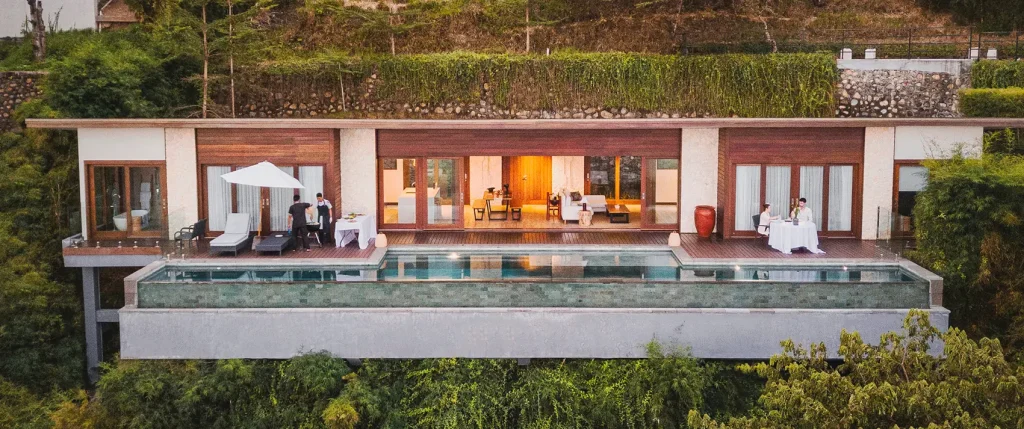
Selong Selo Resort and Villas is located in Selong Belanak, South Lombok — a bay widely regarded as one of the finest in the Indonesian archipelago. The resort comprises 38 architect-designed villas, the Senja Wellness concept, and Aura Restaurant, and was recognised as a 2026 Luxury Lifestyle Awards winner.
Beyond the product, Selong Selo is structured as an integrated hospitality and real estate investment vehicle. The resort-plus-rental model is designed to produce more consistent occupancy and income than a standalone villa operating in isolation. The investment logic is direct: infrastructure spending lifts the value of land and managed property around it, and Selong Selo’s branded residences sit at the intersection of lifestyle value and that investment logic.
The Selong Belanak property market is still in the earlier stages of institutional discovery. That is not a weakness in the thesis — it is the thesis.
Committed Capital vs Portfolio Capital — Why It Matters for Long-Term Investment Value
There is a meaningful distinction between portfolio capital and committed capital in the context of destination development. Portfolio capital — equities, currency positions — moves quickly and leaves when sentiment shifts. Infrastructure-backed hospitality investment is different.
Roads, airports, special economic zones, and resort communities are committed, long-horizon, shovel-in-the-ground capital. It does not exit when a headline turns. The Mandalika SEZ, the arrival of international hospitality brands in Lombok, and the development of branded residences are all expressions of this slower, more durable form of conviction.
Selo Group’s approach to destination development in South Lombok is built on this same premise — regenerative tourism that creates long-term value for the land, the community, and the investor in the same motion. For investors seeking long-term investment value in a market defined by structural tailwinds — not speculative momentum — that distinction is the core of the case.
The Investment Window in Lombok: Why Positioning Now Matters
Lombok has been described as what Bali was fifteen years ago — and that framing is now supported by data, not just instinct. The macro growth, the sovereign infrastructure commitment, the international brand validation, and the emergence of a structured Selong Belanak property market are all pointing in the same direction at the same time.
The question is no longer whether capital is coming to South Lombok real estate. It is who positions ahead of it.
The window for Lombok property investment at pre-discovery pricing is closing. That is not a sales line. It is what the trajectory of comparable destination markets — across Southeast Asia, the Mediterranean, and Central America — has consistently shown.If you would like to go deeper, I am happy to share the Selong Selo investment prospectus or arrange a visit to Selong Belanak. Send me a message directly.
Frequently Asked Questions
What is driving Indonesia’s real estate investment growth in 2026?
Indonesia’s GDP grew 5.61% year-on-year in Q1 2026 — the strongest reading since Q3 2022. The growth is underpinned by a young domestic middle class, rising tourism, and sustained government infrastructure investment, including the Mandalika Special Economic Zone in South Lombok. Taken together, these factors make Indonesia one of the most compelling destinations for long-dated hospitality real estate investment in Southeast Asia.
Why is Lombok property investment attracting international interest?
Lombok remains meaningfully underdiscovered relative to its fundamentals. The island offers the natural appeal of the region without the density of more heavily visited destinations. Sovereign-grade infrastructure investment through the Mandalika SEZ, improving air connectivity, and the arrival of international hospitality brands are all indicators that institutional capital has already underwritten the demand thesis. For investors, Lombok property investment today is positioning ahead of a market that is already in motion.
What makes Selong Selo different from other luxury villas in Lombok?
Selong Selo Resort and Villas is structured as an integrated hospitality and real estate investment vehicle, not simply a collection of private homes for occasional rental. The resort-plus-rental model, managed under the Selo Group brand, produces more consistent occupancy and income than unmanaged product. Combined with the Selong Belanak location, Senja Wellness, and recognition as a 2026 Luxury Lifestyle Awards winner, Selong Selo represents branded residences Lombok at the intersection of lifestyle value and investment logic.
What is the Mandalika SEZ and why does it matter for South Lombok real estate?
The Mandalika Special Economic Zone is a government-designated development zone on Lombok’s southern coast, backed by a US$248 million loan from the Asian Infrastructure Investment Bank. It has delivered roads, utilities, water systems, and regional connectivity that fundamentally changes what is possible in the surrounding South Lombok real estate market. Infrastructure of this scale, committed by sovereign-grade institutions, is the clearest available signal that the long-term demand thesis has been validated.
What is branded residences Lombok and what premium does it carry?
Branded residences are privately owned properties that sit within a managed hospitality brand structure, offering owners both lifestyle use and a managed rental income programme. Globally, branded residences command a 25–35% premium over comparable unbranded product, reflecting brand association, operational quality, and buyer confidence. In Lombok, where price discovery is still maturing, that premium is compounding against a rising base.